

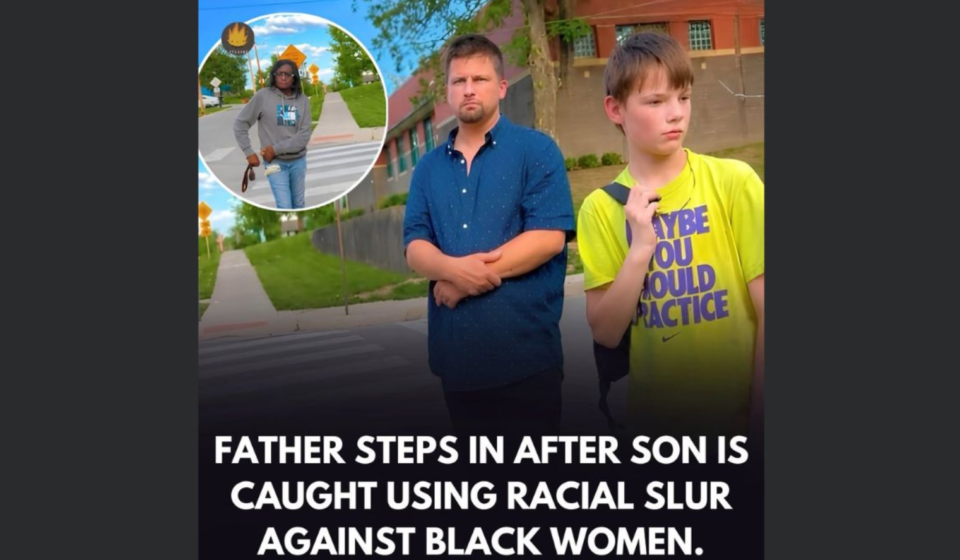
When a Dad Caught His Son Using a Racial Slur, He Did Something Most Parents Would Never Try
Most parents, when they find out their child said something deeply wrong, pull them aside. They close the door. They handle it at the kitchen table or in the car on the way home. That is the default. That is what almost every parent I have ever met would do.
This Ohio father did something different. And the internet has not stopped talking about it.
When he discovered his son had used a racial slur, he did not let it slide and he did not keep it private. He stepped in publicly, made his son face the people his words hurt, and then the story found its way online where thousands of strangers weighed in with opinions that covered every end of the spectrum.
I want to walk through this carefully because there are real questions here worth taking seriously. Not just about this one family, but about how parents handle race, accountability, and discipline in a world where nothing stays private for long.
What Actually Happened in Ohio
The details that made it online show an Ohio father who refused to look the other way when his son used a racial slur. Rather than keeping the discipline behind closed doors, he confronted the behavior directly and required his son to apologize to the people his words affected.
The post spread fast. That part is not surprising. Stories that hit a nerve always do. What was more interesting was what people said once it landed in their feeds.
On one side, people praised the father for not letting his son off easy. On the other side, some questioned whether putting a child’s mistake in front of thousands of strangers was really the right move, even if the intention behind it was good.
Both sides had a point. That is what made this worth writing about.
The Comments Said Everything
When a post like this goes viral, the comments section becomes a kind of public referendum on parenting itself. This one was no different.
One commenter, Kelsie D Junkins Twiggie, defended the father’s choice to intervene, pointing out that what kids do is not always a mirror of their parents, but that the boy was old enough to understand that the language he used was harmful. She also raised something most people had not thought about openly: that using that kind of language could one day put the boy in real physical danger depending on where he says it and who hears it.
That is a practical concern, not just a moral one. She was not just saying it was wrong. She was saying it could have consequences beyond a parent’s timeout.
Jonathan Bates pushed back. His argument was not that the slur was acceptable. It was that broadcasting a child’s worst moment online was its own kind of harm. He put it plainly: why put this on blast for everyone to see rather than keeping it in the family?
Later in the thread, Kelsie walked back part of her support too. She acknowledged that even if the intention was right, some things are better handled without an audience. She said she understood both sides but did not agree with the public post itself.
This back and forth between these two commenters actually captured the whole debate better than any expert panel could. They were not fighting about whether racism is wrong. Nobody disagreed on that. They were fighting about method, and that is where things got genuinely complicated.
Why Parents Discipline Children in Public Now
We are living in a moment where public accountability has become a parenting strategy. This is new. It did not exist twenty years ago in the way it does now.
Some parents post videos of their kids being made to stand on street corners with signs. Some make their children do push-ups in front of neighbors. Some, like this Ohio father, share moments of discipline online where the audience is not just the neighborhood but the entire internet.
The reasoning behind it usually goes something like this: if my child sees that their behavior has real-world consequences beyond just my disappointment, they will take it more seriously. If other people see it, the embarrassment will stick in a way that a private lecture simply will not.
There is research that suggests shame and public accountability can modify behavior. The American Psychological Association has written extensively about how children respond to different forms of discipline. The findings are not simple. Shame that feels constructive and comes from a place of care tends to redirect behavior. Shame that feels humiliating and arbitrary tends to cause withdrawal, resentment, and long-term damage to a child’s sense of self.
The difference between those two outcomes often comes down to how the discipline was delivered, not whether it happened publicly or privately. But putting something online removes the parent’s control over tone entirely. The internet adds its own layer of commentary, mockery, and judgment that the parent never agreed to on the child’s behalf.
When the Lesson Is Right but the Method Raises Questions
Let me say something plainly: this father was right to act. Using a racial slur is not a small thing. It is not a developmental phase. It is not something a parent should quietly correct with a warning and move on. Children who say things like that need to understand why it is wrong, who it hurts, and what kind of person they want to be going forward.
Requiring his son to apologize directly to the people affected was, in my view, the right instinct. That kind of accountability is real. It has weight. The boy had to look someone in the eye and say he was wrong. That is meaningful in a way that writing lines or losing screen time is not.
The part that deserves honest scrutiny is whether sharing it publicly added anything useful to that lesson, or whether it added something harmful alongside it.
A twelve-year-old who says a racial slur is still forming who he is. He made a serious mistake. He should face real consequences for it. But there is a difference between consequences that teach and consequences that define. When something lives online permanently, a moment becomes a label. The boy’s apology, his learning, his growth, none of that gets posted alongside the original clip. The worst moment stands alone.
Child welfare experts consistently note that effective discipline focuses on the behavior, not the child’s character. Public shaming tends to collapse that distinction. The viewer does not see a child making a mistake. They see a bad kid. And that framing can follow a child in ways a parent cannot predict or undo.
The Race Question Cannot Be Separated from This
It would be dishonest to write about this without acknowledging that racial slurs are not generic insults. They carry specific history. They are tied to violence, exclusion, and dehumanization in ways that most other words are not. Parents who encounter this in their children are not dealing with run-of-the-mill bad behavior. They are dealing with something that touches on the deepest fractures in American life.
That context matters for how we evaluate the father’s response. Parents of Black children have a set of concerns about this kind of language that parents of white children may not carry in the same way. The stakes feel different. The urgency feels different. The sense that a child needs to understand this now, not eventually, comes from somewhere real.
Understanding the history of race in America, and why certain words carry the weight they do, is something parents have to actively teach. Children do not come into the world understanding why some words are different from others. They hear things. They repeat them. They test limits. The response they get from adults is how they learn where the lines are and why they exist.
The American Academy of Pediatrics has published guidance for parents and providers on how racism affects children and how adults can address it directly and early. The recommendation is consistent: do not avoid the topic. Name it. Explain it. Hold it up to the light.
This father did that. He just did it with the whole internet watching.
What the Research Says About Kids, Accountability, and Online Exposure
Child development research tells us a few things that are worth knowing here.
First, children between the ages of roughly eight and fifteen are particularly sensitive to social evaluation. Their sense of identity is forming in real time, and how peers and adults respond to their actions has an outsized effect on that formation. Public humiliation during this period can go one of two ways. It can produce genuine reflection and course correction. Or it can produce shame that turns inward and hardens into defensiveness, anger, or withdrawal.
Which way it goes depends largely on whether the child feels, underneath the correction, that they are still loved and still capable of being better. Discipline delivered with warmth, even when it is firm, lands differently than discipline delivered with contempt.
The internet audience is not capable of warmth. It does not know this child. It sees a clip. It renders judgment. That judgment is not always kind and it is not always fair. It cannot be, because the people watching do not have the information a parent has.
Second, the research on children and digital privacy is increasingly clear that children have an interest in their own digital footprint even before they are old enough to manage it themselves. A parent posting a child’s embarrassing or disciplinary moment online is making a choice about that child’s reputation that the child cannot consent to and may not be able to reverse.
This does not mean parents should never share anything about their children online. It means the calculus should include the child’s long-term interests, not just the parent’s immediate goal.
A Personal Note on This
I grew up in a house where my parents were not shy about accountability. If I did something wrong, I apologized. To the person I wronged, in front of whoever was present. There was no negotiating down to a private sorry whispered under the stairs. The apology had to be real and it had to be direct.
I remember being maybe ten years old and repeating something I heard on the playground that I did not fully understand. My mother stopped me mid-sentence, explained exactly why what I just said was harmful, and made me call my friend to apologize before I went to bed. That was uncomfortable. It was also one of the more formative moments of my childhood.
But that friend’s parents did not find out. My school did not find out. It stayed between the people who needed to know. The lesson was complete without an audience.
I think about that when I read stories like this one. The lesson this Ohio boy needed was available without the internet being involved. Whether adding the internet made it better or worse is genuinely unclear to me. What I do know is that the father cared enough to act, and that matters more than it might seem.
How Other Parents Are Handling Race Talks in 2025
If there is one thing this story has done, it has pushed a lot of parents to think about what they would do in the same situation. That is worth something.
Many parents say they avoid the subject of race because they do not know where to start or they are afraid of saying the wrong thing. But silence on this topic is not neutral. Children fill that silence with whatever they are picking up from peers, from media, from the broader culture. Some of what they pick up is accurate. Some of it is not.
Parents who want to raise children who understand the weight of racial language and the history behind it need to have conversations before the crisis moment arrives. The crisis conversation, like the one this Ohio father had, is more effective when it is not the first time the child has heard any of this.
Here is what intentional conversations about race at home can look like in practice:
Start early and keep it age-appropriate. Young children notice race. Pretending they do not often just leaves them without the language to process what they observe. Naming differences matter-of-factly and without shame takes away the taboo that makes children curious in unhelpful directions.
When your child says something concerning, do not panic and do not dismiss it. Ask where they heard it. Ask what they think it means. Find out what they understood before you correct what they got wrong. This tells you a lot more than launching straight into a lecture.
Make the impact concrete. Abstract conversations about prejudice land differently than specific ones. Explaining why a particular word caused a particular person pain, in terms a child can actually picture, is more effective than a general lesson about being nice.
Revisit the conversation. One talk is not enough. Race is not a one-time topic. Children’s understanding of it should grow as they grow.
The Broader Parenting Debate This Story Points To
What this Ohio story really opened up is a debate that parents across the country are having in different forms. Not just about race, but about the role of public accountability in raising children.
Some parents believe that the internet, for all its dangers, has become a genuine tool of community parenting. When a parent posts about a child’s serious mistake, the response from the community can reinforce the lesson in ways that a single adult’s words cannot. The child sees that this is not just their parent’s view. It is widely held. That can have real weight.
Other parents see the internet as fundamentally incompatible with child-rearing. Children’s mistakes should be protected, at least from strangers, so that the child has room to grow into something better without the worst version of themselves being archived permanently.
Neither of these positions is entirely wrong. What they share is a recognition that parenting has always involved the community to some degree. Extended family, neighbors, teachers, coaches, all of these people have historically played a role in shaping children beyond what parents can do alone. The internet is a new version of that community. It is just much larger, far less accountable itself, and entirely missing the warmth and context that make community accountability actually work.
What Effective Accountability for Children Actually Looks Like
If we pull back from the specific case and ask what we actually know about effective accountability for children who do harmful things, the picture is reasonably clear.
The most effective accountability includes a real apology made directly to the person harmed. It includes an explanation of why the behavior was wrong that the child genuinely understands, not just recites. It includes some form of consequence that is proportionate and connected to the harm done. And it includes ongoing conversation, not a single corrective event, to make sure the lesson actually took hold.
What effective accountability does not require is an audience. In fact, the presence of a large audience often changes the nature of the event from a learning experience into a performance. The child is no longer processing their mistake. They are managing how they appear to people watching. Those are very different internal experiences and they produce very different outcomes.
There is also good evidence from developmental psychology research that the parent-child relationship itself is the most powerful lever for behavior change in children. Children who feel securely attached to their parents and who trust that correction comes from love are far more responsive to discipline than children who feel attacked or exposed. Protecting that relationship, even during discipline, is not coddling. It is strategy.
What We Can All Learn from One Family in Ohio
I do not want to be too hard on this father. He did what many parents wish they had the backbone to do. He did not let a serious thing slide. He did not make excuses. He made his son face the consequences of what he said in a direct and meaningful way.
That part of the story is genuinely worth respecting. Too many parents in the same situation would have had a quiet word, accepted a hollow sorry, and moved on hoping it would not happen again. He did not do that.
The part worth sitting with is whether the public posting added value or introduced risk. That question does not have a clean answer. It depends on the child, the family, the community, and outcomes none of us can measure from the outside.
What it does do is give every parent reading it a reason to think through their own approach before they ever find themselves in a similar situation. What would you do? What do you want your child to learn, and from whom? And what do you owe your child in terms of protecting their story as they are still writing it?
Those are the questions this Ohio family handed the rest of us, whether they meant to or not.
Final Thoughts
Racial slurs are not small mistakes. They are not childish slip-ups that warrant a gentle redirect. When a child uses one, a parent has a real responsibility to act, and act clearly. This father understood that. His response, whatever we think of the public component, came from a place of wanting his son to be better. That intention matters.
At the same time, the how of discipline matters just as much as the what. A child who is publicly exposed online carries that with them in ways that are hard to predict and impossible to reverse. The apology, the growth, the conversation that happened after, none of that typically follows the original post into people’s feeds. The mistake does. And that imbalance is worth thinking hard about.
This story will not be the last of its kind. Parents will keep facing moments where they have to decide, fast, how to respond to something their child did that was genuinely wrong. The more we talk honestly about what works and what does not, the better equipped we will all be when that moment comes.
One thing is certain. The families having the hardest conversations are usually the ones doing the most important work. That includes this Ohio dad, even if the method leaves room for debate.